
HSE crackdown on engineered stone silica risks and controls
The Health and Safety Executive (HSE) has published new sector specific guidance on controlling exposure to respirable crystalline silica (RCS) when working with engineered stone, alongside a nationwide inspection campaign targeting fabricators and related businesses. These developments represent a significant and deliberate shift in regulatory expectations, with clear implications for dutyholders under COSHH.
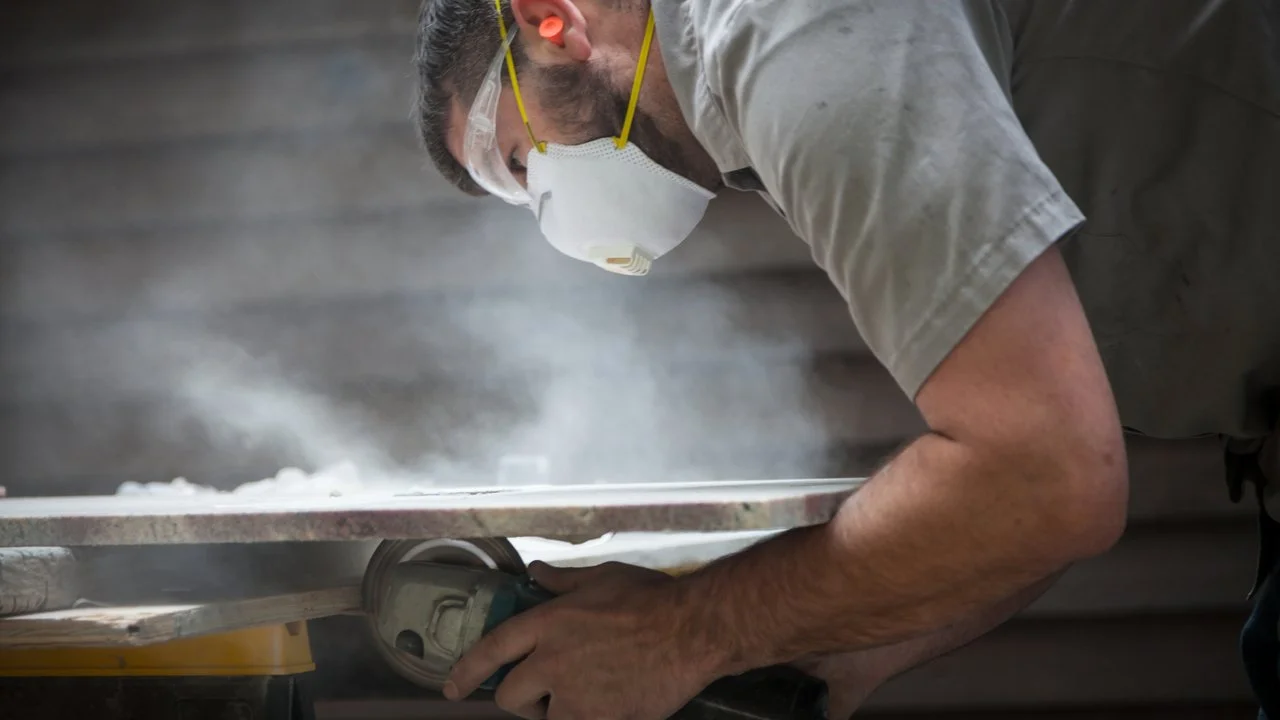
Engineered stone, widely used in kitchen and bathroom worktops, can contain very high levels of crystalline silica, in some cases up to around 95%. When cut, ground or polished, it generates fine airborne dust capable of penetrating deep into the lungs. Exposure to this dust is associated with serious and irreversible health conditions including silicosis, chronic obstructive pulmonary disease (COPD) and lung cancer. Crucially, damage may occur before symptoms emerge, and disease progression can continue even after exposure has ceased.
A step change in regulatory clarity
In its May 2026 update, HSE has issued its first dedicated COSHH guidance for engineered stone and has been unusually explicit in its expectations. Most notably, it has stated that dry cutting of engineered stone is unacceptable, and that water suppression techniques represent the appropriate means of meeting legal obligations.
This is not presented as new law, but as a clear statement of what compliance with existing COSHH duties requires in practice. The guidance therefore removes much of the ambiguity that has historically existed around what constitutes ‘adequate control’ in this sector.
The intervention follows a two year programme of research and industry engagement, prompted by serious cases of silicosis, including fatalities involving relatively young workers.
Key control expectations
The HSE guidance sets out a package of control measures which, taken together, define the expected standard for managing silica risks from engineered stone:
Elimination of dry cutting and similar uncontrolled processes
Use of on-tool water suppression during cutting and processing
Effective control of mist and secondary airborne contamination
Provision of suitable respiratory protective equipment (RPE), including appropriate higher protection factors where required
Selection of lower silica content materials where reasonably practicable
Implementation of health surveillance for exposed workers
These requirements reflect the well established hierarchy of control under COSHH, but are now framed in a way that makes enforcement benchmarks far clearer.
Importantly, HSE’s evidence base indicates that dry processing can result in exposure levels five to ten times higher than equivalent wet methods, reinforcing the regulator’s position on elimination and engineering controls.
Inspection and enforcement focus
Alongside the publication of the guidance, HSE has launched a targeted inspection campaign across Great Britain. Over 1,000 inspection visits are planned over a 12 month period, with inspectors already active in the sector.
Enforcement action is expected where businesses fail to implement the required controls. The combination of clear technical guidance and proactive inspection activity significantly raises the likelihood of enforcement - including notices and prosecutions - for non compliant dutyholders.
Practical implications for businesses
For businesses involved in the manufacture, fabrication, supply or installation of engineered stone products, the key implications are immediate and practical:
Existing COSHH assessments should be revisited to ensure they reflect the latest HSE expectations
Any continued reliance on dry cutting or equivalent processes should be treated as a priority compliance gap
Engineering controls, particularly water suppression and mist management, should be demonstrably effective
RPE should be reviewed as a supplementary control, not a primary solution
Health surveillance programmes should be in place where there is a foreseeable risk of RCS exposure
The guidance is also relevant beyond immediate processing activities. Maintenance, cleaning and downstream installation activities can give rise to exposure and should be considered within the scope of risk assessment.
A predictable enforcement trajectory
From a regulatory perspective, this is a familiar pattern. HSE has translated emerging evidence and high profile cases into sector specific guidance, clarified expectations, and is now reinforcing compliance through targeted inspection and enforcement activity.
Dutyholders should assume that inspectors will take a direct and evidence based approach, using the guidance as a benchmark for compliance. In that context, businesses can expect conversations about whether controls already in place align with what HSE has now clearly set out as the expected standard.
For more detail, see the HSE guidance on working with engineered stone and controlling silica risk and the HSE press release on the inspection campaign and prohibition of dry cutting.