
UK REACH Candidate List of SVHCs updated for the first time since Brexit
On 15 June 2026, the Health and Safety Executive (HSE), the Agency under UK REACH, added 15 entries to the UK REACH Candidate List of substances of very high concern (SVHCs) following a six week consultation process. This marks a significant milestone as the first substantive update to the UK REACH Candidate List since the end of the Brexit implementation period in December 2020.
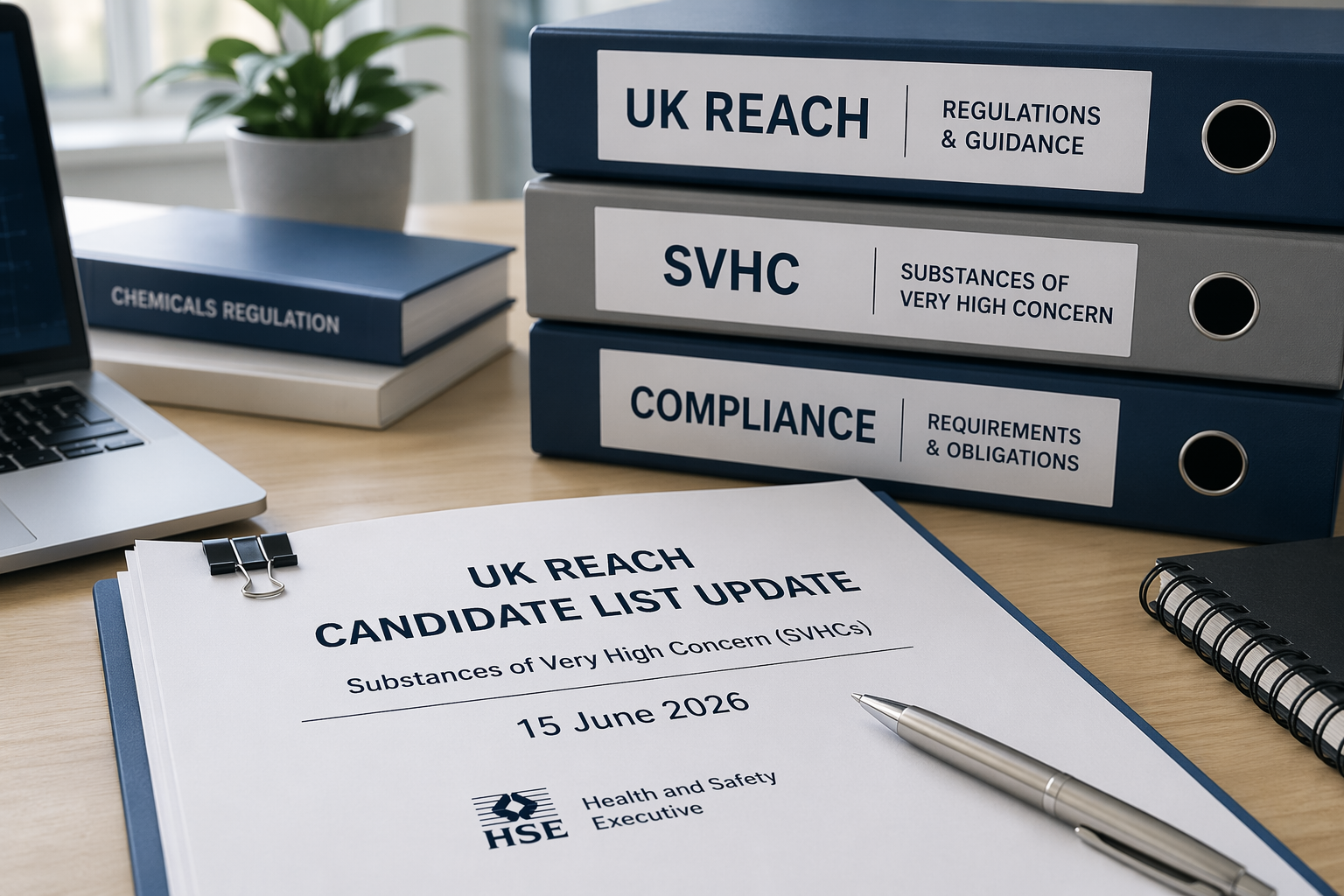
The additions bring the UK REACH regime back into motion after a prolonged period of regulatory stasis. However, despite the headline significance, there is little that is genuinely new from a technical perspective. All of the substances added were already included on the EU REACH Candidate List, and most have well established hazard classifications, primarily relating to carcinogenicity or reproductive toxicity.
This update therefore represents less a divergence from EU REACH and more a clear signal of the UK’s evolving policy position.
A clear shift towards EU alignment
The timing and content of this update align closely with the UK Government’s recently stated policy to prioritise alignment with EU chemicals regulation, using EU decisions as the starting point and diverging only in very limited circumstances.
Earlier in 2026, Defra formally set out a new strategic approach for the UK REACH Candidate List, explicitly committing to draw more heavily on regulatory decisions taken in other jurisdictions, particularly the EU. The intention is to reduce duplication, increase regulatory efficiency and provide greater certainty for industry.
In practical terms, this latest update appears to be the first tangible implementation of that policy. It effectively closes part of the gap that had developed between the EU and UK lists since 2021, when the UK initially ‘froze’ its Candidate List at the point of EU exit.
For businesses operating across both markets, this move will be broadly welcome. Alignment reduces the need for parallel compliance strategies and allows data and supply chain intelligence developed for EU REACH to be leveraged in Great Britain.
What does Candidate List inclusion mean in practice?
Despite not imposing an immediate ban, inclusion on the Candidate List is not merely symbolic. It triggers a suite of immediate legal obligations under UK REACH and serves as an early warning of potential future regulatory control.
Suppliers of substances, mixtures and articles containing these SVHCs must now ensure compliance with several duties, including communicating information on their presence down the supply chain and, in certain cases, notifying HSE of substances present in articles. Most notably, where an SVHC is present in an article above 0.1% by weight, suppliers must provide information to other businesses about the presence of that SVHC and, upon request, to consumers, enabling informed decisions about safe use.
These obligations apply immediately upon listing, and there is no grace period for compliance. As such, affected businesses should already be assessing their exposure and supply chains.
A precursor to authorisation?
In regulatory terms, the Candidate List is a staging post rather than an end point. Substances identified as SVHCs may be prioritised for inclusion in the UK REACH Authorisation List (Annex XIV), where their use is only permitted if a specific authorisation is granted or an exemption applies.
This raises an important question for industry: will the UK now begin to move more actively towards authorisation decisions, drawing again on EU precedents?
While no such prioritisation has yet been announced in relation to these substances, the broader policy direction suggests that further steps towards Annex XIV inclusion may follow in due course. For businesses, the prudent assumption is that Candidate List inclusion should trigger forward looking substitution planning, rather than a narrow compliance exercise.
What should businesses do now?
From a practical perspective, companies should treat this development as both a compliance trigger and a strategic signal.
Immediate actions typically include confirming whether any of the listed substances are present in products, updating safety data sheets and technical documentation, communicating with customers and suppliers, and assessing any potential notification duties.
However, the more important implication lies in forward planning. Candidate List inclusion often drives market pressure well before formal regulatory controls are imposed, with customers increasingly expecting proactive substitution or justification of continued use.
For organisations with complex supply chains, this is also a reminder of the importance of robust substance tracking and data collection systems. The fact that all substances added are already regulated under EU REACH may simplify this task, but only where existing compliance frameworks are properly aligned and maintained.
Further information: UK REACH candidate list https://www.hse.gov.uk/reach/candidate-list.htm